

- September 29, 2026
- by thetbcindia
- Podcast Production
- 629 Views
- 0 Comments
Podcasting has become an important content format for businesses, entrepreneurs, professionals, educators, creators and personal brands. A podcast can provide a platform for sharing expertise, interviewing industry leaders, discussing business ideas and building a deeper connection with an audience.
However, producing a professional podcast involves much more than recording a conversation.
A successful podcast requires planning, recording, audio production, video production, editing, content repurposing and distribution. The quality of each stage can influence how the final podcast looks and sounds.
This is where professional podcast production in Mumbai can become valuable.
Mumbai has a growing ecosystem of businesses, creators, founders, professionals and media teams producing podcasts for different purposes. Some podcasts are designed primarily for audio platforms, while others are recorded as video podcasts for YouTube, Instagram, LinkedIn and other digital channels.
For businesses, podcast production can also become part of a broader content marketing strategy. A single conversation with a founder, customer or industry expert can potentially be transformed into a long-form episode, short videos, social media clips, blog content and other digital assets.
This complete guide explains what podcast production involves, how the production process works, what equipment and services may be required, how businesses and creators can plan their podcast and what to consider when choosing a podcast production company in Mumbai.
1. What Is Podcast Production?
Podcast production refers to the complete process of creating a podcast episode, from planning and recording to editing and final delivery.
Recording is only one part of the process.
A professional podcast may involve several stages that work together to produce the final episode.
Podcast production can include:
- Topic and content planning
- Guest coordination
- Recording preparation
- Audio recording
- Video recording
- Lighting and camera setup
- Audio editing
- Video editing
- Quality control
The exact process depends on the podcast format.
A solo audio podcast may have a relatively simple production workflow.
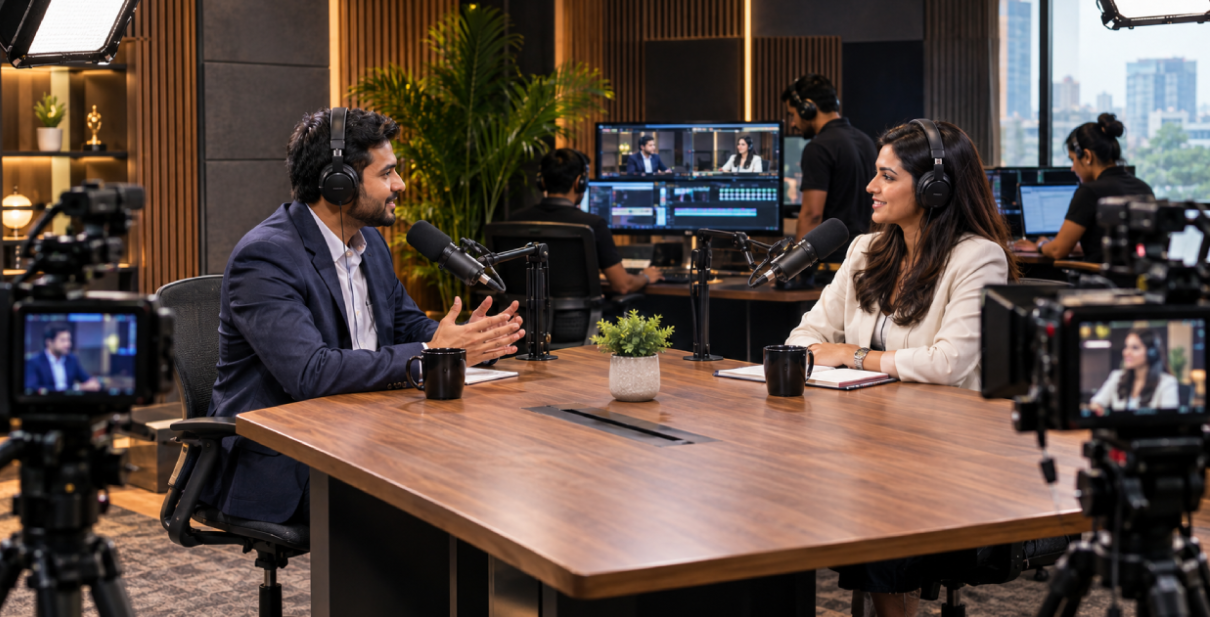
A multi-camera business interview can require several microphones, cameras, lighting systems, an audio engineer and video editing.
Professional podcast production in Mumbai can therefore range from basic recording support to a complete end-to-end production service.
Before starting, businesses and creators should determine how much of the production process they want to handle internally and how much they want a professional production team to manage.
2. Why Are Businesses Using Podcasts for Content Marketing?
Podcasts can provide businesses with a long-form format for communicating ideas that may be difficult to explain through short advertisements or social media posts.
A founder can discuss the company’s journey, an industry expert can explain a complex subject and a professional can answer common customer questions.
The conversational format can also make business communication more personal.
Businesses can use podcasts to:
- Share industry knowledge
- Build brand awareness
- Interview experts
- Discuss customer problems
- Showcase company expertise
- Introduce founders and leadership teams
- Explain products or services
- Build professional communities
- Create educational content
A podcast should not simply be created because podcasting is popular.
It should have a clear purpose.
For example, a consulting company might create a podcast around business strategy, while a healthcare organization may focus on educational conversations with specialists.
A technology company could interview founders and industry experts about emerging trends.
The topic should connect with the interests of the intended audience.
Professional podcast production in Mumbai can then help turn that strategy into consistent, high-quality content.
3. Why Are Creators Investing in Professional Podcast Production?
Podcasts are not limited to large companies.
Independent creators, coaches, educators, consultants, influencers and subject-matter experts can also use podcasts to build their personal brands.
Creators often need to produce content consistently while maintaining professional quality.
A professional production team can reduce the technical workload.
Instead of worrying about camera settings, audio levels, lighting and editing, creators can focus on the conversation and content.
Professional production can help creators with:
- Consistent recording quality
- Better audio
- Professional video
- Multi-camera footage
- Editing
- Social media clips
- Captions
This can be especially useful for creators who want to record several episodes in one session.
For example, a creator could schedule multiple interviews on the same recording day and have the production team process the footage afterward.
The objective is not necessarily to make every podcast look highly cinematic.
Consistency is often more important.
A recognizable recording environment, consistent audio and visual style can help establish a stronger content identity over time.
4. What Does a Professional Podcast Production Process Include?
A professional podcast production workflow generally begins before the recording session.
Planning helps reduce technical and content-related problems later.
A typical production workflow includes:
Pre-production
The team plans the topic, format, guests, questions, schedule and recording requirements.
Studio preparation
Microphones, cameras, lighting, seating and recording systems are prepared.
Recording
The host and guests record the conversation while the production team monitors audio and video.
Post-production
The raw recordings are edited to improve flow, remove unwanted sections and synchronize audio and video.
Content repurposing
Selected portions can be converted into short-form videos, clips and other content.
Quality control
The final files are reviewed before delivery.
Publishing preparation
Files may be formatted for different platforms.
A structured workflow reduces the possibility of missing important production steps.
It also makes recurring podcast production easier because the same process can be repeated for every episode.
For businesses planning a regular podcast series, establishing this workflow early can make production more efficient as the number of episodes increases.
5. How Important Is Audio Quality in Podcast Production?
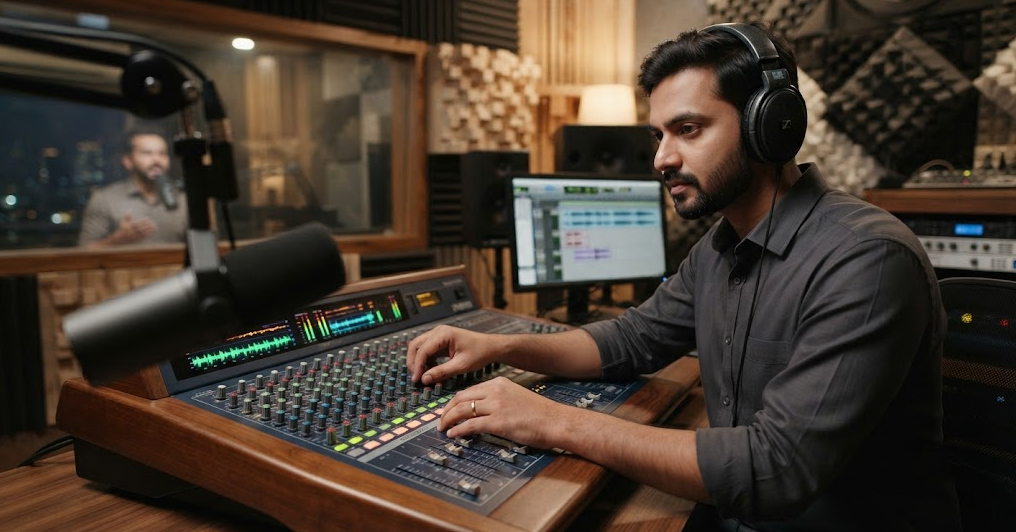
Audio is one of the most important elements of a podcast.
Listeners may forgive simple visuals, but distracting background noise, echo or inconsistent voice levels can make a podcast uncomfortable to hear.
Professional podcast production therefore starts with a suitable recording environment.
Good podcast audio generally requires:
- Appropriate microphones
- Controlled acoustics
- Correct microphone placement
- Proper recording levels
- Monitoring through headphones
- Background noise control
- Consistent voice levels
- Professional audio editing
The room itself matters.
Recording in a large untreated room can produce unwanted reflections and echo.
A professionally treated studio can help create a cleaner recording environment.
Post-production can also improve the raw recording.
An editor may remove unwanted noises, reduce distracting sections, balance audio levels and make voices more consistent.
However, editing cannot completely compensate for poor recording conditions.
This is why choosing the right recording environment is an important part of professional podcast production in Mumbai.
6. Should Businesses Record Video Podcasts?
For many businesses, video podcasting can provide additional opportunities for content distribution.
A video podcast can be published as a full episode on YouTube while also being divided into shorter clips for social media.
A video podcast can potentially generate:
- Full YouTube episodes
- Instagram Reels
- LinkedIn videos
- YouTube Shorts
- Guest clips
- Educational snippets
- Promotional content
- Quote-based social posts
Video also allows audiences to see the people involved in the conversation.
This can be useful for founder-led brands, professional services companies and expert-driven businesses.
However, video production requires additional planning.
Lighting, camera angles, backgrounds, clothing, seating positions and visual consistency all become relevant.
If video is part of your strategy, choose a production setup designed for both audio and video rather than simply adding a camera to an audio recording.
A professional video podcast should be planned as a complete visual production.
7. What Role Do Cameras and Lighting Play in Podcast Production?
Camera quality alone does not determine whether a video podcast looks professional.
Lighting, camera positioning, background design and framing all contribute to the final result.
A multi-camera setup can provide different perspectives during editing.
For example, one camera may capture the host, another the guest and a third a wider shot.
A professional video podcast setup may include:
- Multiple cameras
- Tripods or fixed camera positions
- Professional lenses
- Soft key lighting
- Fill lighting
- Background lighting
- Controlled exposure
- Consistent framing
Lighting should also be appropriate for the skin tones of the people being recorded.
A professional production team can adjust lighting based on the studio environment, number of participants and camera setup.
The background should support the podcast rather than distract from the speakers.
For a business podcast, a clean branded environment may be appropriate.
For a creator podcast, a more distinctive visual setting may help establish the creator’s identity.
8. What Happens During Podcast Post-Production?
The recording session creates the raw material.
Post-production turns that material into a finished episode.
The level of editing depends on the podcast format and publishing requirements.
Audio post-production may include:
- Removing unwanted noise
- Reducing unnecessary pauses
- Adjusting audio levels
- Improving consistency between speakers
- Removing technical mistakes
- Adding intro and outro elements
- Final audio mastering
- Consistent framing
Video post-production may include
- Camera switching
- Removing unwanted sections
- Audio-video synchronization
- Color correction
- Basic visual adjustments
- Graphics
- Captions
- Intro and outro
The goal should be to improve the content without making the conversation feel unnatural.
Heavy editing is not always necessary.
For an interview podcast, preserving the natural flow of the conversation may be more important than removing every pause.
The editing approach should therefore match the brand and podcast format.
Businesses should discuss their preferred editing style with the production team before recording.
9. How Can One Podcast Episode Become Multiple Pieces of Content?
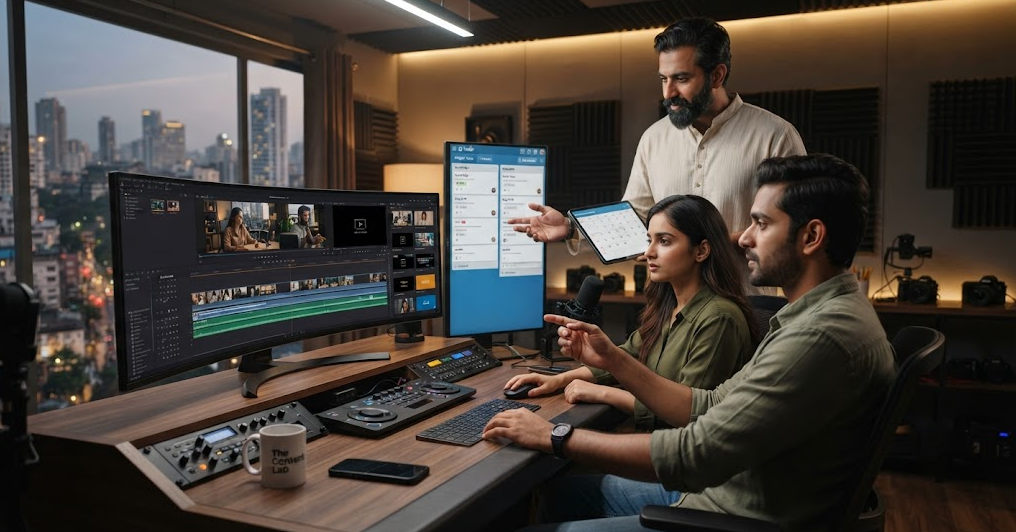
One of the biggest advantages of podcast production for businesses and creators is content repurposing.
A single long-form conversation can contain dozens of useful moments.
For example, a 45-minute interview might contain several strong insights that can be converted into short videos.
One episode can potentially become:
- Full podcast episode
- YouTube video
- Multiple short-form clips
- Instagram Reels
- YouTube Shorts
- LinkedIn videos
- Quote graphics
- Blog article
- Website content
- Newsletter content
This approach can make podcast production part of a larger content system.
Instead of creating every social media post separately, businesses can extract content from conversations they are already recording.
10. How Should Businesses Plan Their Podcast Content Strategy?
Professional production cannot compensate for unclear content.
Before recording, businesses should determine what they want the podcast to achieve.
Start by defining:
Target audience
Who should listen to the podcast?
Core topics
What subjects will the podcast consistently discuss?
Podcast format
Will it be interviews, solo episodes, panel discussions or conversations?
Episode length
Will episodes typically be 20 minutes, 45 minutes, 60 minutes or another duration?
Publishing frequency
Will the podcast be weekly, fortnightly or monthly?
Guest strategy
Which experts, customers, founders or professionals could contribute?
Distribution
Where will the podcast be published?
Repurposing
Which platforms will use the short-form content?
A consistent strategy helps the audience understand what to expect.
Businesses should also avoid making every episode a direct sales pitch.
Educational and genuinely useful conversations can often provide more value than promotional discussions.
The podcast should give the audience a reason to return.
Professional podcast production in Mumbai can then provide the technical and creative infrastructure required to execute that content strategy consistently.
Conclusion
Professional podcast production in Mumbai involves much more than recording audio.
A successful podcast requires planning, a suitable recording environment, quality microphones, professional video equipment where required, controlled lighting, technical monitoring, editing and a clear content strategy.
For businesses, podcasting can become a valuable long-form content format for sharing expertise, interviewing industry professionals, introducing leadership teams and creating educational conversations.
For creators, podcast production can provide a consistent way to develop high-quality content while reducing the technical burden associated with recording and editing.
The biggest opportunity is often content repurposing.
A single podcast conversation can potentially become a full episode, YouTube video, short-form videos, social media content, blog material and other digital assets.
Frequently Asked Questions
1. What is included in podcast production?
Podcast production can include pre-production planning, studio recording, audio production, video recording, editing, captions, short-form clips, graphics and final file delivery. The exact services depend on the production package.
2. How much does podcast production cost in Mumbai?
The cost varies according to recording duration, studio setup, number of cameras, technical support, editing, number of clips and other production requirements. Businesses should compare complete deliverables rather than only studio rental prices.
3. Is professional podcast production necessary for businesses?
It is not mandatory, but professional production can help businesses achieve more consistent audio and video quality and reduce the technical workload involved in producing episodes.
4. Can podcast production include video?
Yes. Many podcast production setups include multi-camera video recording, professional lighting and video editing for platforms such as YouTube and social media.
5. What equipment is required for professional podcast production?
A professional setup may include broadcast-quality microphones, headphones, audio recording equipment, cameras, lighting, acoustic treatment and monitoring equipment.
6. Can one podcast episode be used for social media?
Yes. A full podcast can potentially be repurposed into short videos, reels, YouTube Shorts, LinkedIn clips, blog content and other digital assets.
7. How long should a business podcast episode be?
There is no universal ideal length. The appropriate duration depends on the topic, format and audience. A useful conversation should generally be long enough to provide value without adding unnecessary content.
8. Should a business choose audio-only or video podcast production?
It depends on the business’s content strategy. Video can provide additional opportunities for YouTube and short-form social content, while audio-only production may be suitable when visual distribution is not a priority.
9. How often should a podcast be published?
Businesses can choose a weekly, fortnightly or monthly schedule depending on their resources and content strategy. Consistency is generally more practical than selecting a frequency that is difficult to maintain.
10. How do I choose podcast production services in Mumbai?
Review previous work, audio and video quality, studio equipment, technical support, editing services, content repurposing, turnaround time, communication and the complete production scope before making a decision.