



Spoken English for Stand-Up Comedians – Find Your Voice, Own the Room, Make the Laugh Land Every Time
Spoken English for Stand-Up Comedians
Comedy Is the Hardest English in the World. Get It Right and the Room Is Yours.
Stand-Up Comedy in English Is a Different Game Entirely
Anyone who has ever stood at an open mic knows the feeling. The material is ready. The timing has been rehearsed. The punchline that killed at home in the mirror is sitting right there, loaded and waiting. And then the English – the specific word, the precise rhythm, the exact intonation that the joke needs to land – does not arrive the way it did in the rehearsal. It arrives slightly wrong. Slightly flat. Slightly off the beat that comedy lives and dies on.
The laugh does not come.
Stand-up comedy in English is one of the most demanding communication challenges in any professional or creative field. It requires everything that all other forms of spoken English require – fluency, vocabulary, pronunciation, confidence, natural delivery – and then it requires something more. Something that cannot be faked and cannot be approximated. The specific linguistic precision, the rhythmic control, the culturally attuned word choice, and the effortless naturalness that makes a joke land rather than thud.
In English, comedy is even more specifically demanding than in a mother tongue. The wordplay depends on exact phonological knowledge. The cultural reference requires genuine understanding of the context the audience is bringing. The timing is not just about pause length – it is about the specific cadence of the English sentence, the weight of the syllable, the intonation rise that signals the setup and the drop that delivers the punchline.
For comedians who are performing in English as a second or third language – or who grew up speaking English but in a variety or register that the English-medium comedy circuit does not always reward – the gap between the joke in the mind and the joke in the room is often not a comedy problem. It is a language problem. And language problems have language solutions.
ARTH by TBC India’s Spoken English Coaching for Stand-Up Comedians is that solution. One-on-one. Completely personalised. Built around your specific comedic voice, your material, your performance context, and the specific English communication challenges that your comedy career is navigating.
The English That Comedy Demands - And Why It Is So Specific
Most comedians who perform in English understand intuitively that the English of comedy is different from the English of other professional contexts. But it helps to be specific about why – because the specificity is the key to developing it effectively.
Timing Is a Language Phenomenon
The most fundamental element of stand-up comedy – timing – is not purely about pause length or performance instinct. It is deeply linguistic. The beat before the punchline is not the same length in every sentence. It depends on the specific phonological weight of the words leading into it. It depends on the syllable count of the setup. It depends on the specific rhythm of the English sentence structure that the joke is built on.
A comedian who does not yet have automatic, fluent English processes this rhythm consciously – which means there is always a slight delay, a slight calculation, between the linguistic construction and the performance delivery. And comedy does not survive slight delays. The split second of conscious language processing is enough to flatten the timing that the joke depends on.
Genuine English fluency – the automatic, effortless English production that does not require conscious management – is the foundation of comedy timing. And it is what ARTH’s coaching is designed to develop.
Word Choice Is Everything
The difference between the word that makes the joke funny and the word that makes it merely descriptive is often a single syllable, a specific phonological quality, a cultural association that the right word carries and the wrong word does not. English comedy vocabulary is not the same as general English vocabulary. The words that are funny – the words whose sounds, associations, and cultural weight carry comedic energy – are a specific subset of the English lexicon. And knowing them, deploying them naturally, and finding them in real time without the gap of vocabulary searching is a specific language skill.
Register Flexibility Is the Comedian's Superpower
The best English-language stand-up comedians move between registers with remarkable fluidity. From the elevated to the colloquial. From the formal to the street. From the precise to the deliberately imprecise. This register flexibility – the ability to inhabit multiple English registers and move between them at will, for comedic effect – is one of the most sophisticated linguistic capabilities that stand-up comedy demands. And it is one that can be deliberately developed through the right coaching approach.
Accent and Phonology as Comedy Tools
For many stand-up comedians in India, accent is itself a comedic resource. The ability to deploy, exaggerate, contrast, and play with accent and phonological variety – to use the diversity of Indian English as a source of comedic commentary – requires a specific and sophisticated understanding of English phonology that goes well beyond the accent work most English coaches cover. ARTH’s coaching for comedians addresses this specific dimension with the nuance and the creative intelligence it requires.
What Makes ARTH's Coaching Right for Stand-Up Comedians

Built Around Your Comedic Voice
No two comedians have the same voice. No two comedians have the same material, the same audience, the same performance context, or the same English communication starting point.
ARTH’s coaching is built entirely around your specific comedic identity – your material, your performance style, the English challenges that your specific comedy career is navigating, and the specific version of English fluency and linguistic sophistication that your voice most requires. Not a standard communication course. Not a generic fluency program. A coaching engagement built around you and your comedy.
This is the same philosophy behind our one-on-one English coaching approach – complete personalisation, no templates, no assumptions about what the average learner needs. For comedians, whose entire craft depends on the specific rather than the average, this personalisation is not a feature. It is the requirement.

Private Sessions - Safe Space for Creative Risk
Comedy development requires the freedom to fail. The joke that does not work. The delivery that is off. The word that is almost right but not quite. These are not failures. They are the essential raw material of the development process.
But they require safety to work with. The freedom to try the risky version of the joke. The space to experiment with the English of the punchline without the performance pressure of a live audience. The one-on-one coaching session is that space – the one environment where the comedian can take the creative risks that their development requires without the consequence of a real audience response.

English That Serves Comedy - Not Comedy That Serves English
This is the most important distinction in ARTH’s coaching for stand-up comedians. The goal is never to make your comedy conform to a standard English model. The goal is to make your English serve your comedy – to give you the complete linguistic control, the register flexibility, the phonological precision, and the vocabulary depth that allows your comedic vision to come through in English exactly as you intend it to.
Your accent is not a problem to be solved. Your regional English variety is not an inadequacy to be corrected. Your specific linguistic identity is a comedic resource to be understood, controlled, and deployed with the intentionality of an artist who knows exactly what they are doing with every linguistic choice they make.

Timing, Rhythm, and the Musicality of English Comedy
ARTH’s coaching for comedians specifically addresses the linguistic dimensions of comedy timing – the phonological rhythm of the English sentence, the syllabic weight that determines where the comedic beat falls, the intonation patterns that signal setup versus punchline, and the delivery naturalness that comes from genuine English fluency rather than performed confidence.
This is not performance coaching. It is linguistic coaching that serves performance – developing the English automaticity that frees the comedian’s performance instincts to do their job without language management getting in the way.

The Become Friends With English Philosophy
For a stand-up comedian, becoming friends with English is not a metaphor. It is the literal requirement of the craft. The comedian who is friends with English – who moves through the language with the ease and the playfulness of genuine fluency – can do things with it that the comedian who is managing it cannot. They can bend it. They can subvert it. They can play with it, break it, put it back together in unexpected ways, and use its specific properties for comedic effect. The comedian who is friends with English owns it. The one who is managing it is owned by it.
ARTH’s coaching builds this friendship. Not just fluency. Genuine linguistic comfort, flexibility, and the creative relationship with the English language that the most compelling English-language stand-up comedy requires.

Flexible Scheduling for the Comedian's Life
Open mics on weeknights. Gigs on weekends. Writing sessions at unconventional hours. The creative professional’s schedule does not fit conventional coaching timetables.
ARTH’s sessions are arranged around your availability – whenever your creative and performance calendar creates a coaching window. Online when your location makes in-person impractical. In-person when you want the depth of a face-to-face session. The coaching fits your creative life. It never competes with it.

20+ Years of Expertise, 5000+ Learners Transformed
Who This Coaching Is For
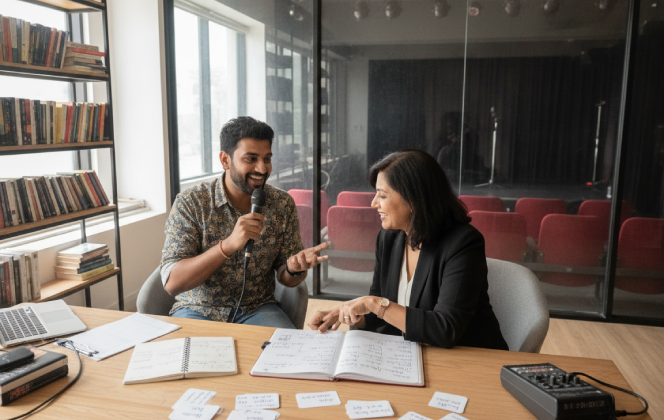
Comedians Transitioning From Regional Language to English Comedy
Stand-up comedians who have developed their craft in Hindi, Marathi, Tamil, Telugu, or another Indian language and who are now building an English-language comedy career – and for whom the transition from performing in the language they are most fluent in to performing in a language they are developing fluency in is the specific and immediately consequential challenge their comedy career is navigating.
For these comedians, the gap between their comedic capability – which may be genuinely advanced – and their English fluency – which is still developing – is the most acutely felt professional challenge in their creative life. ARTH’s coaching bridges this gap specifically, efficiently, and with the creative intelligence that comedy development requires.
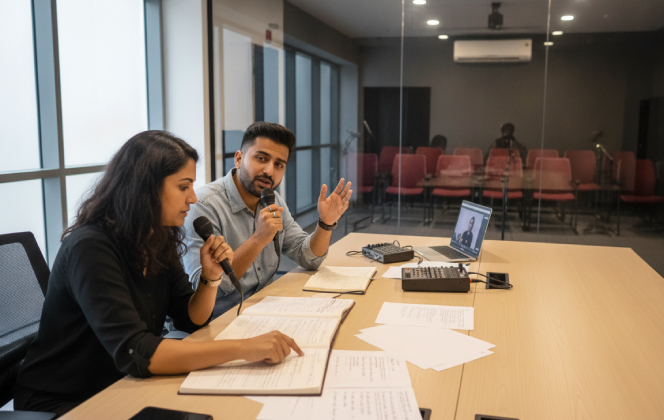
English-Speaking Comedians Refining Their Craft
Comedians who already perform in English but who know – from audience response, from peer feedback, from their own honest assessment – that their English is not yet doing their comedy justice. The jokes that almost land but not quite. The timing that is close but not precise. The word choices that are approximately right but not exactly right. The accent work that is almost convincing but slightly off. ARTH’s coaching for these comedians develops the specific refinements that move comedy from almost working to genuinely landing.
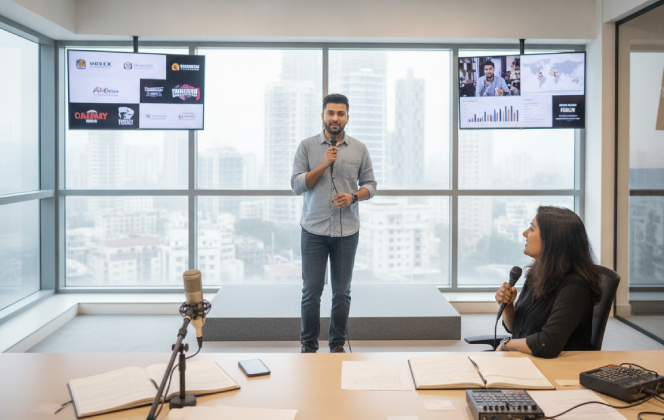
Comedians Building an International Audience
Indian stand-up comedians who are building careers beyond the domestic English comedy circuit – targeting international festival slots, global streaming comedy specials, international touring, and the English-language comedy audiences of the diaspora and the broader global comedy market – and for whom the English of their comedy needs to function not just for the Indian English comedy audience but for the wider international English-speaking comedy audience whose cultural references, linguistic expectations, and comedy sensibilities are different in specific and consequential ways.
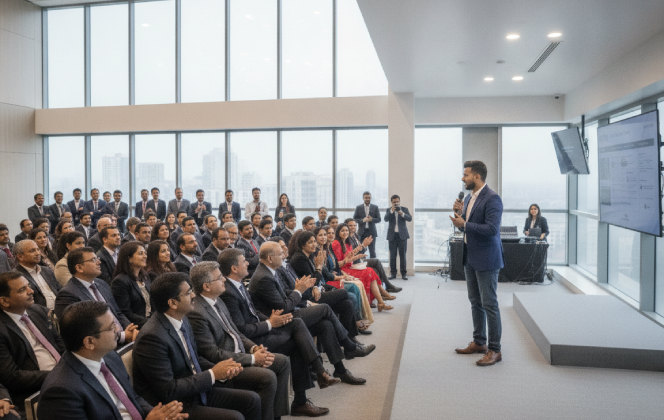
Corporate Comedians and MC Professionals
Comedians who perform at corporate events, award ceremonies, conferences, and the full range of professional entertainment contexts where the English of the performance needs to be simultaneously entertaining, professionally appropriate, and linguistically calibrated to an audience whose English expectations are shaped by the corporate professional environment rather than the comedy club.

Writers and Comedians Developing English Material
Comedians who write their own material and who are discovering that the English of the written joke and the English of the performed joke are two different things – and that developing the specific English fluency of live performance requires a different kind of development from the English fluency of written comedy writing.

Aspiring Comedians at the Beginning of Their English Comedy Career
New comedians who are at the beginning of their English comedy journey – who have the comedic instinct, the observational intelligence, and the performance ambition, and who want to build their English comedy career on a foundation of genuine linguistic fluency rather than discovering the language limitations of their English mid-career, when the cost of those limitations is higher.
What the Coaching Covers
English Fluency as the Foundation of Comedy Timing
The most fundamental development in ARTH's comedy coaching is the development of genuine English fluency - the automatic, effortless, real-time English production that does not require conscious management and that frees the comedian's timing instincts to do their job without linguistic interference.
This fluency development happens through sustained, specifically calibrated speaking practice - not comedy performance practice, but the underlying English speaking practice that builds the linguistic automaticity that comedy timing depends on. The ability to produce any word, any phrase, any sentence structure at the speed that comedy requires, without the split-second delay of conscious linguistic processing that is the enemy of timing.
We measure progress not by how funny the jokes are getting - that is the comedian's job - but by how naturally and how automatically the English is flowing. When the English is flowing, the comedy takes care of itself.
Comedy Vocabulary and the Language of the Punchline
Not all English words are equally funny. This is a linguistic fact, not a subjective judgment. Certain phonological properties - the presence of plosive consonants, specific vowel qualities, the number of syllables and where the stress falls - make some words carry more comedic energy than others in English. The best English-language comedians know this intuitively. ARTH's coaching develops it explicitly.
Beyond the phonological comedy of individual words, the coaching addresses the vocabulary of the comedian's specific comedic voice - the specific lexicon that carries the comedian's identity, their worldview, their cultural positioning, and the specific way they see and describe the world. Developing this vocabulary - not in the general sense of building English word knowledge but in the specific sense of identifying and internalising the words that are most authentically, most distinctively, most comedically this particular comedian - is one of the most creative and most rewarding dimensions of the coaching.
Register Play and Linguistic Flexibility
The ability to move between registers - to jump from the elevated to the colloquial, from the formal to the street, from the academic to the absurd - is one of the English-language stand-up comedian's most powerful tools. It is also one of the most linguistically demanding.
ARTH's coaching develops register flexibility through specific, targeted practice in moving between English registers with the naturalness and the control that makes the register jump itself a comedic event. The comedian who can switch from speaking like an RBI circular to speaking like a Mumbai autowala in a single sentence - and who can do it with perfect linguistic control of both registers - has a comedy tool that the comedian who operates only in one register simply does not possess.
Pronunciation, Accent, and Phonological Comedy
For Indian stand-up comedians, accent and pronunciation are not just personal characteristics - they are creative resources. The ability to deploy, exaggerate, and contrast accent varieties - to use the phonological diversity of Indian English for comedic commentary on class, region, aspiration, and cultural identity - requires a sophisticated and specifically developed phonological awareness.
ARTH's coaching addresses this specifically - developing the comedian's phonological range, their control of accent modulation, and their ability to use the specific sounds of English and Indian English varieties with the intentional precision of an artist who is making deliberate linguistic choices rather than defaulting to whatever is most natural.
Delivery, Rhythm, and the Musicality of the Set
A stand-up set is a musical performance as much as it is a linguistic one. The rhythm of the sentences. The pace variation between setups and punchlines. The breath control that determines whether a run of jokes lands as a connected sequence or feels like a series of isolated observations. The silence management that makes the audience lean forward rather than drift.
ARTH's coaching addresses the musical dimensions of English comedy delivery - the specific rhythm patterns that make English comedy sentences feel right, the pacing strategies that build and release comedic tension across the arc of a set, and the delivery naturalness that comes from genuine English fluency rather than performance technique grafted onto language management.
Audience Reading and Real-Time Linguistic Adaptation
The ability to read an audience and adapt in real time - to shorten a setup that is losing the room, to extend a bit that is landing, to improvise around an unexpected audience response - is one of the most advanced stand-up comedy skills. It is also one of the most linguistically demanding, because it requires the real-time production of new English - unrehearsed, spontaneous, contextually appropriate English - under the full performance pressure of a live audience.
ARTH's coaching develops the real-time English production capability that crowd work and audience adaptation require - through progressive improvisation exercises and spontaneous speaking practice that build the English automaticity and the cognitive flexibility that in-the-moment comedic adaptation demands.
Backstage and Industry English
The comedy industry - the festival circuit, the streaming platform, the comedy club booking conversation, the podcast appearance, the media interview - requires its own English communication capability that is distinct from the performance English of the set itself. The pitch conversation with the festival programmer. The streaming platform meeting where the comedy special concept is being sold. The podcast appearance where the comedian's off-stage personality needs to be as engaging as their on-stage one.
ARTH's coaching for comedians addresses this industry communication dimension - developing the professional English of the comedy industry relationship, the media interview naturalness, and the personal brand communication that makes a stand-up comedian compelling not just on stage but in every professional context their comedy career places them in.
Our spoken English for actors, models and hosts page covers several of the same off-stage English communication challenges that stand-up comedians face - particularly around media interviews, brand communication, and personal presence in professional contexts.
The Coaching Experience
Your Initial Consultation
A completely private, confidential conversation with a senior ARTH coach. No test. No standardised evaluation. A genuine conversation about your comedy, your English, your specific challenges, and what you want your language to do for your comedy that it does not currently do with the ease and the control your creative vision requires.
You leave with a clear, specific picture of what a coaching program built around your comedic voice and your English development needs would look like. No obligation. No commitment. Just clarity about the path.
Your Program
Built from scratch around your specific comedic voice, your material, your performance context, your English starting point, and your comedy career goals. Ready before your first session. Evolving continuously as the coaching relationship develops and your comedy develops alongside it.
Your Sessions
Entirely private. A creative, engaged, linguistically specific coaching space where the English development and the comedy development inform each other. Speaking practice that is targeted at the specific linguistic capabilities your comedy most requires. Specific, honest, immediately applicable feedback. Scheduled around your creative and performance calendar.
Between Sessions
Material review from the English perspective – not the comedy perspective, which is yours – looking at vocabulary choices, rhythm patterns, and the specific linguistic elements that are serving the comedy and those that are not yet. Preparation for specific upcoming performances or industry meetings. The ongoing creative partnership of a coach who is genuinely invested in the development of your comedic voice.
Related Resources
If you are building a broader creative career alongside your stand-up comedy, these ARTH resources are relevant to the professional communication demands your career creates.
Our spoken English for actors, models and hosts page covers the media interview, brand communication, and public presence English that comedians navigating the entertainment industry need alongside their performance language.
Our spoken English for media and entertainment industry page is valuable for comedians who are building relationships with streaming platforms, production companies, and the broader entertainment ecosystem that the most commercially successful comedy careers engage with.
Our personal English coaching for celebrities in Mumbai page covers the specific confidentiality, personalisation, and professional English development needs of high-profile performers – directly relevant to comedians who are building significant public profiles.
Externally, the Comedy Store India is India’s premier comedy club and a central institution of the English-language stand-up comedy circuit – the professional context that many of ARTH’s comedy coaching clients are performing in or aspiring to perform in. The Netflix Is A Joke Festival represents the kind of international English-language comedy platform that the most ambitious Indian English-language comedians are building towards – a useful lens for understanding the English communication standard that international comedy audiences and platforms expect.
Frequently Asked Questions
Is this coaching about making me funnier or improving my English?
Both – but in a specific order. ARTH’s coaching develops your English. The comedy is yours. What the coaching does is remove the English limitations that are preventing your comedy from landing the way your comedic instinct intends it to. When the English is genuinely fluent, genuinely natural, and genuinely under your control, the comedy you already have comes through more completely, more precisely, and more consistently. The coaching gives your comedy the English it deserves.
Is this suitable for comedians who perform in Indian English rather than received pronunciation?
Absolutely. ARTH’s coaching is not about changing your English variety or moving your accent towards a British or American standard. It is about developing your control of the English you perform in – deepening your fluency, expanding your register range, sharpening your phonological precision, and giving you the complete linguistic toolkit that allows your specific comedic voice to come through with full control and full intention.
Can ARTH help me develop specific material I am working on?
The coaching engages with your material from the English perspective – looking at vocabulary choices, rhythm patterns, and the specific linguistic elements that are working for or against the comedy. The creative development of the material itself is your work. But the English dimension of that material – the specific words, rhythms, and delivery choices that make it land in English – is exactly where ARTH’s coaching adds the most direct value.
Is the coaching confidential?
Completely. Your program, your material, your challenges, your progress, and the existence of the coaching relationship are entirely private – never disclosed to anyone in the comedy industry or anywhere else.
Can sessions be scheduled around open mics and performance commitments?
Yes. Scheduling flexibility is absolute. Sessions are arranged around your performance calendar – whatever your open mic schedule, your touring commitments, and your creative writing rhythms allow.
How do I start?
Call +91 98926 92555, email info@thetbcindia.com, or use the enquiry form on this page. All enquiries are completely confidential. We will arrange a private initial consultation at a time that works for your schedule.

Your Comedy Deserves English That Does It Justice
The jokes are there. The comedic vision is real. The observational intelligence that makes a great stand-up comedian is genuinely yours.
Now give it the English that lets all of it land - every time, in every room, for every audience - with the precision, the naturalness, and the complete linguistic control that the craft demands.
With 20+ years of expertise, 5000+ transformed learners, and coaching built entirely around your comedic voice - ARTH is ready.
One mentor. One comedian. Infinite possibility.
[Enquire About Spoken English Coaching for Stand-Up Comedians] [Call Us: +91 98926 92555] [Email: info@thetbcindia.com]